🔒

Review Access

This paper is currently under review. Please enter the password to continue.

Home Theory Take Action Impact

What if cognitive aging isn't about losing brain cells,
but about losing the insulation between them?

Neuroscience · New Hypothesis

Decoherence via
Demyelination

A Hypothesized Mechanism of Cognitive Decline

The DDH: healthy myelinated axon with oligodendrocyte (left) vs. aging demyelinated axon (right) showing degraded signal transmission

Iosif M. Gershteyn, Nikola T. Markov, Joel Kramer, Kaitlin Casaletto, Lisa M. Ellerby, David Furman
Buck Institute · UCSF Memory & Aging Center · Stanford University · MUSC

Preprint on bioRxiv: coming soon
700
Participants
ages 40 – 99
28
White matter
tracts analyzed
34
Cortical brain
regions mapped
Scroll to explore

Understanding the Theory

Start with the big picture. Go deeper when you're ready.

1
The Big Picture: no science background needed

01Your Brain Is an Orchestra

Your brain is not a single computer. It is a network of roughly 86 billion neurons organized into dozens of specialized regions, each handling a different job, from recognizing faces to planning tomorrow. Thinking, remembering, and deciding require many of these regions to activate at the same time, in precise coordination.

The Concert Hall: Imagine an orchestra whose musicians sit in different buildings across a city, connected only by cables carrying their sound. For the symphony to work, every note must arrive at the mixing board within milliseconds of the right beat. If even one cable introduces a delay, that section falls out of rhythm and the whole piece suffers.

In the brain, those cables are white matter tractsWhite Matter TractsBundles of nerve fibers that connect distant brain regions, like internal cables.
Full glossary entry →
: bundles of long nerve fibers that link distant regions. Each fiber is wrapped in a fatty coating called myelinMyelinA fatty insulating coating on nerve fibers that speeds up and stabilizes signals.
Full glossary entry →
. Myelin does two things: it speeds up electrical signals (from ~1 m/s to ~100 m/s) and, critically, it keeps their timing precise.

02What Goes Wrong With Age?

Signal Speed: Young vs. Aging Brain

Young
brain
Fast &
precise
Aging
brain
Slow &
jittery

Colored bands = myelin insulation. Gaps in the lower track show where myelin has degraded. The signal pulse travels noticeably slower.

As we age, this myelin coating breaks down, but not uniformly. Tracts serving memory, complex reasoning, and language degrade fastest. Tracts handling basic vision and movement are largely spared. This uneven pattern explains why an 80-year-old may struggle to find a word mid-sentence yet walk across a room without difficulty.

Uneven Wear: Imagine the cable to the oboe section fraying while the violin cable stays intact. The oboist still plays perfectly, but their notes arrive a beat late. The audience hears dissonance, not because anyone forgot the music, but because the delivery infrastructure failed selectively.

03The "Decoherence" Part

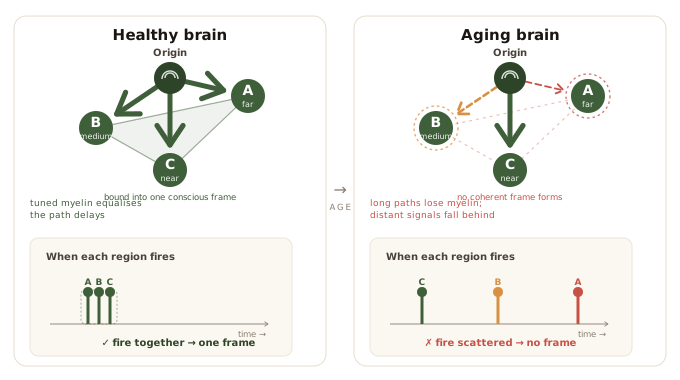
Synchronized vs. Desynchronized Brain Networks

Young / Healthy
Regions fire in coordinated rhythms.
Signals arrive in phase.
Aging / Demyelinated
Uneven myelin loss disrupts timing.
Signals arrive out of phase.

The word coherence means waves moving in lockstep. DecoherenceDecoherenceLoss of synchronization between brain signals, disrupting coordinated network activity.
Full glossary entry →
means they have drifted apart. The DDH borrows this concept from physics to describe what happens in the aging brain: different regions need to oscillate in synchronized rhythms (like musicians keeping a shared tempo) to produce thought. When myelin degrades at different rates across different pathways, signals arrive at the wrong phase of these rhythms, and the synchronization breaks down.

Age-related cognitive decline is driven less by neurons dying than by the connections between brain regions losing their precise timing, because the myelin insulation on those connections is degrading at different rates in different pathways.

04Which Abilities Decline, and When

Severity of Myelin Loss by Brain Pathway

Higher-order thinking tracts (red/orange) lose myelin much faster than basic sensory & motor tracts (green). This matches the real-world pattern: complex reasoning slows before walking or seeing does.

The "Hockey Stick" Curve: Nonlinear Decline After Age 60

Schematic of FA (fiber integrity) vs. age for higher-order cognitive tracts. Decline is gradual until ~60, then accelerates sharply. Each line represents a different tract; red tracts are most affected.

Ages 20 – 40

Myelin reaches peak thickness. Brain networks synchronize with minimal effort. Cognitive processing speed and mental flexibility are at their lifetime maximum.

Ages 40 – 60

Gradual, mostly linear decline begins in select tracts. You may notice slightly slower word retrieval or reduced ease in switching between tasks.

Ages 60+

Decline accelerates nonlinearly in many key pathways (a 'hockey-stick' curve). Processing speed drops measurably; multitasking and novel problem-solving become harder.

05Why This Gives Us Hope

If the core problem is degrading insulation rather than dying neurons, the therapeutic target changes entirely. The brain's wiring plan remains intact. What fails is the myelin that keeps signals on schedule. This opens a different class of interventions:

  • Repairing or maintaining the myelin coating
  • Supporting the cells that produce myelin (oligodendrocytesOligodendrocytesBrain cells that produce and maintain myelin insulation around nerve fibers.
    Full glossary entry →
    )
  • Reducing inflammation that damages myelin-producing cells
  • Cognitive training that may stimulate natural remyelination

The wiring diagram of the brain is still there. We just need to keep its insulation healthy.

2
The Mechanism: undergraduate / graduate level

From Localized to Distributed Computation

Early neuroscience, shaped by studies of focal brain lesions, assumed each function lived in one area. Modern imaging (fMRI, MEG) and large-scale neural recordings have overturned this view. Cognitive operations (attention, memory, reasoning) emerge from coordinated activity across distributed functional networks, not from any single region:

  • Frontoparietal / multiple-demand network: executive control, working memory, fluid reasoning
  • Dorsal & ventral attention networks: top-down spatial attention vs. stimulus-driven reorienting
  • Limbic & medial temporal lobe systems: episodic memory formation, emotion processing
  • Default mode network: self-referential thought, memory consolidation, mind-wandering
  • Sensorimotor circuits: coordinated movement execution

These networks reconfigure dynamically depending on the task. Their proper function depends on inter-regional oscillatory synchronyOscillatory SynchronyBrain regions vibrating in coordinated rhythms to enable communication.
Full glossary entry →
: neurons in distant areas must fire in coordinated, phase-locked rhythms (in the gamma, beta, and theta frequency bands). Disrupting this synchrony disrupts the computation itself.

Myelin: The Precision Timing Infrastructure

Myelin sheaths enable saltatory conductionSaltatory ConductionElectrical signals jumping between gaps in myelin, traveling up to 100x faster.
Full glossary entry →
: electrical signals jump between gaps (Nodes of Ranvier) along the axon, dramatically increasing speed. But speed alone is not enough. Myelin also reduces temporal jitterTemporal JitterRandom variation in signal arrival times; myelin minimizes this variation.
Full glossary entry →
: it narrows the variance in when each action potential arrives at its target. This precision is what allows incoming signals to land within the correct excitatory phase window of the target circuit's oscillation.

Even millisecond-scale timing deviations can push incoming signals from an excitatory phase window into an inhibitory one, fundamentally disrupting inter-regional communication. Myelin precision is not a luxury; it's a computational necessity.

Why Timing Precision Matters: Phase Alignment

Target
oscillation
Myelinated
signal
Demyelinated
signal

The target circuit oscillates (top). A myelinated signal (middle) arrives in phase with the excitatory window (green zone). A demyelinated signal (bottom) arrives late, hitting the inhibitory window (red zone), and the message is effectively blocked.

Critically, myelination is not static. Myelin plasticity provides a second learning system alongside Hebbian plasticityHebbian Plasticity'Neurons that fire together wire together': learning at the synapse level.
Full glossary entry →
:

Hebbian Plasticity

Operates at the vertex level, strengthening or weakening synaptic weights at individual nodes of the network.

Myelin Plasticity

Operates at the edge level, tuning the conduction properties of the connections between nodes. Oligodendrocytes build "smart wiring": active axons become more heavily myelinated.

Evidence for myelin plasticity is direct: blocking oligodendrocyte differentiation prevents mice from learning new motor skills. Conversely, motor learning triggers oligodendrocyte proliferation. In humans, both working memory and episodic memory require the generation of new myelinating oligodendrocytes, establishing myelin plasticity as essential for cognition, not just motor function.

Non-Uniform Tract Degradation: DTI Evidence

Using diffusion-weighted MRI on ~700 participants (ages 40–99), two complementary metrics were measured across 28 white matter tracts:

Fractional Anisotropy (FA)Fractional AnisotropyA score (0–1) measuring how organized nerve fibers are; lower means more damage.
Full glossary entry →

Directional coherence of water diffusion. High FA = well-organized fibers. Decreases indicate disorganization and demyelination.

Mean Diffusivity (MD)Mean DiffusivityHow freely water moves in brain tissue; higher values indicate tissue damage.
Full glossary entry →

Overall water molecule movement. Low MD = dense, well-myelinated tissue. Increases indicate expanded extracellular space from myelin/cell loss.

FA Decline by Tract (β coefficients, robust linear model)

Higher-order cognitive tracts (red) show the steepest decline. Sensory/motor pathways (green) are relatively spared. 15 of 28 tracts showed nonlinear (accelerating) decline after ~age 60.

Figure 2: FA trajectories across white matter pathways
FIGURE 2 Age-related FA trajectories across major white matter pathways. Scatter plots show FA vs. age (gray dots, N=638). Green curves = nonlinear (quadratic); orange = linear; purple = no detectable age effect. Table shows model selection diagnostics including ΔAIC and Akaike weights (ω).
Supplementary Figure 1: FA and MD beta estimates
SUPP. FIG 1 Magnitude of age effects on FA (A) and MD (B) across all white matter tracts. Points = robust linear model β estimates; red bars = bootstrapped 95% CIs. Tracts ordered by effect magnitude. FA shows negative age effects (fiber disorganization); MD shows positive effects (increased extracellular water).
TractFunctionFA βTrajectory
Uncinate fasciculusSocial-emotional, memory, language−0.0027Nonlinear (ω=1.00)
Fornix (column & body)Episodic memory, spatial navigation−0.0026Nonlinear
Ant. limb internal capsuleExecutive control, decision making−0.0024Nonlinear (ω=1.00)
Corpus callosum (body/genu)Interhemispheric communicationmoderateMixed
Corticospinal tractMotor controlmildLinear / minimal
Cerebellar pedunclesMotor coordinationmildLinear / minimal

NODDI: What's Actually Changing at the Microstructural Level

FA/MD conflate multiple tissue properties. NODDINODDIAn advanced MRI analysis separating nerve fiber density from surrounding water.
Full glossary entry →
(Neurite Orientation Dispersion and Density Imaging) separates three compartments in white matter "cushions" under 34 cortical regions:

ficv ↓
Intracellular volume
Decreases (neurite loss)
fiso ↑
Free water fraction
Increases (tissue loss)
odi —
Orientation dispersion
Unchanged with age

Visualizing the Three NODDI Compartments

Young White Matter
Dense neurites, thin water layer, intact myelin
Aging White Matter
Fewer neurites, more free water, degraded myelin

Critical insight: The fiber architecture (odi) is preserved. The brain's wiring diagram remains intact with age. What degrades is the supporting cellular environment: neurite density drops (ficv, likely reflecting oligodendrocyte and myelin sheath loss) and free water fills the vacated space (fiso). In short, the cables are still routed correctly, but their insulation is thinning. This pattern implicates glial/myelin failure rather than axonal death.

Figure 3: NODDI age effects across 34 brain regions
FIGURE 3 Age effects on three NODDI parameters across 34 cortical white matter cushions. β coefficients from robust linear models (NODDI ~ Age + Sex). ficv shows widespread negative effects (neurite loss); fiso shows mirror-image positive effects (free water gain); odi shows minimal age dependence. Red bars = 95% bootstrap CIs.

Linking Structure to Cognition: CCA

Canonical Correlation AnalysisCCAA statistical method for finding the strongest shared patterns between two datasets.
Full glossary entry →
between all NODDI metrics (102 imaging variables) and 7 cognitive assessments revealed a single dominant mode:

R = 0.72
Canonical correlation
52%
Shared variance explained
p < 10⁻¹⁶
Statistical significance

Imaging Side (U1): Top Contributors

  • Parahippocampal fiso: −0.26
  • Lingual fiso: −0.25
  • Medial orbitofrontal fiso: −0.21
  • Parahippocampal odi: −0.16

Predominantly driven by fiso in association cortex.

Cognition Side (V1): Loadings

  • Spatial reaction time: −0.61
  • Verbal reaction time: −0.55
  • Executive function: 0.46
  • MMSE (global cognition): 0.38
  • Animal naming: 0.35
  • Memory z-score: 0.26

Processing speed (measured by reaction times) is the cognitive domain most tightly coupled to white matter microstructural damage. Executive function and global cognition follow. Critically, age is the dominant axis along which structural damage and cognitive decline co-vary: younger participants cluster in the high-integrity / high-performance quadrant; older participants cluster in the opposite corner.

3
Full Technical Detail: researchers & specialists

Cohort & Data Architecture

Hillblom Aging Network, UCSF Memory & Aging Center. IRB-approved; written informed consent. 638 complete observations after exclusion, ages 40–100.

MRI Acquisition Protocol

Siemens Trio 3T or Prisma 3T scanners. MPRAGE T1w: TR/TE/TI = 2300/2.98/900ms (Trio), 2300/2.9/900ms (Prisma); flip angle 9°; FOV 240×256mm; 1mm isotropic; sagittal orientation. Diffusion MRI: multi-shell sampling for DTI and NODDI. Preprocessing: eddy current correction, motion correction, susceptibility distortion correction, B0 field correction. Scanner harmonization: empirical Bayes ComBat across all sessions.

Data Preprocessing Pipeline

Cognitive–MRI matching: nearest assessment within ±2-year window (temporally closest when multiple available). Sessions missing >35% cognitive variables excluded. Remaining gaps: age-neighborhood median imputation (±5 years, ≥3 observations required). Single visit per patient retained.

Hemispheric averaging: between-subject variability ≫ within-subject laterality; left/right values averaged per tract. Outlier screening: sex-stratified LOESS (span=0.75), IQR residuals, median+3×IQR threshold → entire subject exclusion.

Neuropsychological Battery

Seven measures: MMSE (global cognition), GDS (geriatric depression), memory z-score (episodic memory), animal naming (semantic fluency), executive/bedside z-score (executive function), verbal reaction time, spatial reaction time (processing speed). Assessments matched within 1-year window of imaging for CCA.

Diffusion Model Specifications

Tensor model: Standard tensor fitting → FA and MD. Harmonized via ComBat. NODDI model: Three retained parameters: intracellular volume fraction (fICV), isotropic free water fraction (fISO), orientation dispersion index (ODI). Parcellation: Atlas-based white matter ROIs; left/right averaged.

Statistical Framework

Robust Linear RegressionRobust Linear ModelA regression method resistant to outlier data points, using the Huber estimator.
Full glossary entry →
(MASS package, R 4.4.1) using the Huber psi-function with iteratively reweighted least squares (IRLS). This M-estimator downweights outlier influence without assuming normality. Because p-values are unreliable under these conditions, statistical inference relies on 1000 nonparametric bootstrapBootstrapEstimating statistical confidence by repeatedly resampling from observed data.
Full glossary entry →
iterations
yielding 95% percentile confidence intervals. An effect is deemed significant when the CI excludes zero.

DTI | NODDI metric ~ Age + Sex

Model selection (linear vs. nonlinear trajectories):

  • Null: lm(metric ~ sex)
  • Linear: lm(metric ~ age + sex)
  • Quadratic: lm(metric ~ poly(age, 2) + sex)

Nested ANOVA F-tests: null vs. linear (Plinear) and linear vs. quadratic (Pnonlinear). Information-theoretic criteria:

ΔAICAICA score balancing model fit against complexity; lower is better.
Full glossary entry →
= AIClinear − AICnonlinear
ωi = exp(−½Δi) / ∑j exp(−½Δj)

Decision rule for retaining quadratic: Pnonlinear < 0.05 AND ΔAIC ≤ −2 AND/OR ωnonlinear ≥ 0.70. Otherwise retain linear if Plinear < 0.05, else classify as "none" (no detectable age effect).

Note: Posterior corona radiata reached nonlinear significance but failed the linear test; visual inspection confirmed outlier-driven → classified as "none."

Quantitative FA Results

15/28 tracts showed strong nonlinear evidence (ω > 0.77). 8 tracts best fit linear. 5 tracts showed no significant age effects.

TractβageΔAICωNLModel
Internal capsule ant. limb−0.0024−26.881.00Nonlinear
Uncinate fasciculus−0.0027−26.651.00Nonlinear
Splenium corpus callosum−26.081.00Nonlinear
Fornix (column & body)−0.0026>0.77Nonlinear
Anterior corona radiataLinear
Genu corpus callosumLinear
Internal capsule post. limbNone

MD trajectories: All 28 tracts showed significant nonlinear relationships (ω ≥ 0.93). Universal J/U-shaped pattern confirmed by 5-year bin averaging. Strongest: internal capsule ant. limb (ΔAIC = −64.83), splenium (ΔAIC = −42.53), uncinate fasciculus (ΔAIC = −29.07).

Supplementary Figure 2: MD trajectories
SUPP. FIG 2 MD trajectories show universal nonlinear age effects across all 28 tracts (ω ≥ 0.93). J/U-shaped patterns confirmed by 5-year bin averaging. Strongest acceleration: internal capsule anterior limb (ΔAIC = −64.83).

NODDI Microstructural Decomposition

Robust linear models across 34 cortical white matter cushion parcels:

  • ficv: Widespread negative β. Strongest: banks of STS, inferior temporal, temporal pole (β ≈ −0.002 to −0.001). Also robust: entorhinal cortex, insula, anterior cingulate, BA44, BA45. All CIs exclude zero.
  • fiso: Mirror-image positive β. Strongest: BA44/BA45 (language, executive), lingual (visual word recognition), pericalcarine (visual), cingulate cortex. β ≈ 0.001 to 0.002.
  • odi: Minimal age effects. β estimates clustered near zero; CIs frequently cross zero. Age-invariant.

Interpretation: Fiber architecture preserved; cellular environment degrades. Consistent with oligodendrocyte/myelin loss > axonal degeneration. Spatial heterogeneity in ficv/fiso sensitivity recapitulates tract-level FA/MD hierarchy.

CCA: Multivariate Brain–Cognition Coupling

Design: X = 34 parcels × 3 NODDI metrics (102 variables). Y = 7 cognitive measures. Both standardized (zero mean, unit variance). Canonical variates computed in standardized form. Structure correlations = cor(X, U) and cor(Y, V). Significance: Wilks' lambdaWilks' LambdaA test statistic for determining if CCA results are statistically significant.
Full glossary entry →
F-test (yacca). Age regression on all variates with FDR correctionFDR CorrectionA method to reduce false positives when running many statistical tests.
Full glossary entry →
.

R = 0.72
CV1 canonical correlation
R² = 0.52
Shared variance
p < 2.2×10⁻¹&sup6;
Wilks' lambda
CV2–7
Not significant (FDR)

Age loading on CV1: U1 ~ Age: β = 0.041 ± 0.002 (p < 0.001). V1 ~ Age: β = −0.058 ± 0.003 (p < 0.001). Age is the dominant axis of the brain–cognition relationship in this cohort.

Figure 4: Canonical Correlation Analysis results
FIGURE 4 CCA reveals age as the dominant axis linking white matter damage to cognitive decline. (A) CV1 scatter colored by age: younger participants (green) cluster upper-right; older (red) cluster lower-left. R=0.72, p<2.2×10⁻¹⁶. (B) Top imaging contributors dominated by fiso. (C) Cognitive loadings: processing speed (reaction times) is the strongest contributor.

Supplementary CCA Analysis (Fig. S3): Scree plot confirms CV1 as the only significant dimension (R²=0.52). Age regression with FDR correction shows U1 (β=0.041, p<0.001) and V1 (β=−0.058, p<0.001) are both age-dependent. Cross-domain correlation matrix reveals fiso measures have the highest correlations with cognitive variables. Within-imaging correlations show little structure within each NODDI model, confirming that CCA captures genuinely multivariate relationships. Full supplementary panels available in the preprint.

Theoretical Integration: The DDH Framework

Three developmental waves of myelin change (establishment in childhood, maturation in adolescence, atrophy in aging) map onto three major classes of neurological disease: neurodevelopmental, psychiatric, and neurodegenerative, respectively. Genes associated with all three disease classes are enriched in oligodendrocyte lineage cells, suggesting that myelin biology is a shared vulnerability axis across the lifespan.

Wave 1 · Childhood
Establishment
Initial myelination of major pathways. Disruptions → neurodevelopmental disorders (autism, ADHD)
Wave 2 · Adolescence
Maturation
Fine-tuning of prefrontal connectivity. Disruptions → psychiatric disorders (schizophrenia, bipolar)
Wave 3 · Aging
Atrophy
Progressive myelin loss, accelerating after 60. Disruptions → neurodegenerative conditions (Alzheimer's, cognitive decline)

The activity-dependent feedback loop that maintains myelin:

The Myelin Plasticity Feedback Loop

Neural Activity Oligodendrogenesis Myelin Densification improved synchrony → reinforced activity

Age-related breakdown of this loop (e.g., via inflammatory signaling to OPC/OL populations) cascades into progressive decoherence of functional networks. This positions myelin maintenance as a potential intervention point.

What You Can Do

This theory opens doors for different communities. Find yours.

For Researchers

The full preprint with methods, data tables, and supplementary figures will be available on bioRxiv. We welcome replication, extension, and collaboration.

  • Cite the preprint (link coming soon)
  • Request access to de-identified data
  • Contact for collaboration

nmarkov@buckinstitute.org

For Industry & Clinicians

The DDH identifies myelin maintenance as a tractable therapeutic target, distinct from amyloid or tau-focused approaches. Key areas of opportunity:

  • OPC-promoting small molecules
  • Anti-inflammatory myelin-protective agents
  • Tract-specific imaging biomarkers for clinical trials
  • Neuroscience-inspired AI architectures

For Patients & Families

If you or someone you love is experiencing age-related cognitive changes, here's what this research suggests:

  • The brain's wiring is likely still intact; the insulation is what's degrading
  • This opens new avenues for treatment beyond current approaches
  • Staying cognitively active may help maintain myelin through activity-dependent plasticity

This is an active area of research. Consult your physician for personalized medical advice.

Why This Matters

The DDH reframes cognitive aging and opens new therapeutic directions.

A Paradigm Shift

Prevailing models of cognitive aging emphasize neuronal death and synaptic degradation. The DDH proposes a different primary driver: loss of inter-regional timing precision caused by heterogeneous myelin degradation across white matter pathways.

This reframes the therapeutic target. Rather than trying to keep individual neurons alive, interventions can aim to preserve or restore the connective infrastructure: the myelin that synchronizes distributed brain networks.

Therapeutic Avenues

  • Promoting oligodendrocyte precursor cell (OPC) proliferation and differentiation
  • Reducing neuroinflammation that impairs OL function
  • Activity-dependent interventions that drive remyelination
  • Tract-specific myelin biomarkers for early detection
  • Targeted pharmacological support for myelin maintenance
Was this explanation clear and helpful?
Thank you. Your feedback helps us improve this explanation.