Review access
New hypothesis · Preprint forthcoming

What if cognitive aging isn't about losing brain cells, but losing the right timing?

Decoherence via Demyelination

A hypothesized mechanism of cognitive decline, tested in 638 humans across the second half of life.

Cohort 638 adults, ages 40–99, UCSF Hillblom Aging Network
Method Diffusion-weighted MRI · FA, MD, NODDI · CCA with cognition
Coupling R = 0.72, p < 2.2×10⁻¹⁶, 52% shared variance
The DDH: healthy myelinated axon with oligodendrocyte (left) vs. aging demyelinated axon (right) showing degraded signal transmission
Healthy · ~100 m/s Aging · ~1–10 m/s
Authors
Iosif M. Gershteyn*†, Nikola T. Markov*†, Joel Kramer, Kaitlin Casaletto, Molly Olzinski, Lisa M. Ellerby, David Furman*
MUSC · Ajax Biomedical Foundation · ImmuVia Inc. · Buck Institute for Research on Aging · UCSF Memory & Aging Center · Stanford University School of Medicine
*Corresponding authors   Equal contribution
01
The theory, told three ways.

Plain language first. Mechanism second. Full technical detail third. Read as far as is useful.

iThe big picture — no science background needed
01Architecture

Your brain is not a single computer. It is an orchestra of regions.

The brain is a network of roughly 86 billion neurons organized into dozens of specialized regions, each handling a different job — recognizing faces, planning tomorrow, reading this sentence. Thinking, remembering, and deciding require many of these regions to activate at the same time, in precise coordination.

The concert hall. Imagine an orchestra whose musicians sit in different buildings across a city, connected only by cables carrying their sound. For the symphony to work, every note must arrive at the mixing board within milliseconds of the right beat. If even one cable introduces a delay, that section falls out of rhythm and the whole piece suffers.

In the brain, those cables are white matter tracts: bundles of long nerve fibers that link distant regions. Each fiber is wrapped in a fatty coating called myelin. Myelin does two things: it speeds up electrical signals (from ~1 m/s to ~100 m/s) and, critically, it keeps their timing precise.

02Aging

As we age, the insulation breaks down — but not uniformly.

Tracts serving memory, complex reasoning, and language — the uncinate fasciculus and fornix among them — degrade fastest. Tracts handling basic vision and movement are largely spared. This uneven pattern explains why an 80-year-old may struggle to find a word mid-sentence yet walk across a room without difficulty.

Two effects combine to produce the pattern: late-developing pathways start with thinner myelin than early-developing ones, and they lose myelin faster with age. Our diffusion-MRI data measure the second — heterogeneous loss rates, not just starting differences. The pattern is well-documented in the white-matter aging literature; the DDH takes the heterogeneity as an empirical given and traces its functional consequences for cognition.

Uneven wear. Imagine the cable to the oboe section fraying while the violin cable stays intact. The oboist still plays perfectly, but their notes arrive a beat late. The audience hears dissonance — not because anyone forgot the music, but because the delivery infrastructure failed selectively.

03The name

When the timing drifts, the symphony decoheres.

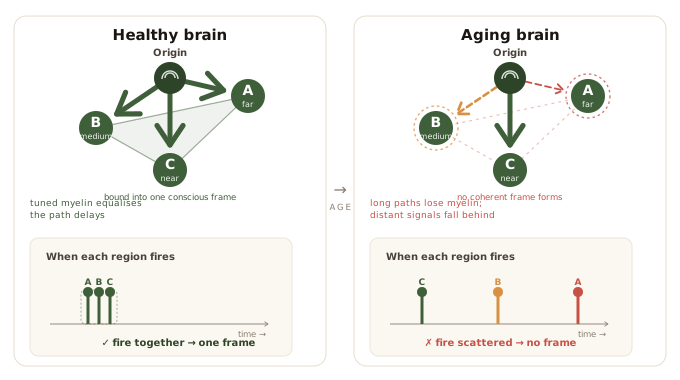
The word coherence means waves moving in lockstep. Decoherence means they have drifted apart. Different brain regions need to oscillate in synchronized rhythms (like musicians keeping a shared tempo) to produce thought. When myelin degrades at different rates across different pathways, signals arrive at the wrong phase of these rhythms, and the synchronization breaks down.

The borrowing is metaphorical. DDH describes a classical mechanism — heterogeneous conduction delays in physical wiring — not a quantum-mechanical phenomenon. What both senses share is the loss of phase-coherence among elements of a system.

Synchronized vs desynchronized signal arrival across three brain regions converging on a receiving area
Overview Coherent vs decoherent arrival. Spikes from prefrontal cortex, parietal cortex, and hippocampus travel along myelinated axons toward a shared receiving region. With intact myelin (left) they arrive aligned and summate cleanly. After heterogeneous demyelination (right) arrival times scatter — the receiving region sees temporal jitter instead of a coordinated input.
Figure 1C: Effect of heterogeneous demyelination on network synchrony
Fig 1C Effect of heterogeneous (uneven) demyelination on network synchrony. Three projection sources (a, b, c) converge on a receiving area (d). With intact myelin (left), all signals arrive coordinated and produce synchronous spike patterns. With age-related uneven demyelination (right), conduction times drift apart and the once-coherent assembly becomes asynchronous.
Coherent
Spikes arrive in phase. Assemblies form, summation is efficient, cognition proceeds normally.
Decoherent
Arrival timing scattered by heterogeneous myelin loss. Assembly formation fails; processing speed degrades.

Heterogeneous, age-related demyelination of long-range white matter projections disrupts conduction timing, degrades the inter-regional neuronal communication coherence required for distributed cognition, and produces the cognitive deficits characteristic of normal aging.

04Trajectory

Which abilities decline — and when.

Some pathways begin to lose integrity around midlife. Higher-order thinking tracts (red on Fig 2; uncinate fasciculus, fornix, internal capsule anterior limb) lose myelin much faster than basic sensory and motor tracts (green). This matches the real-world pattern of cognitive aging: complex reasoning slows before walking or seeing does.

The trajectory is not linear. In 15 of 28 tracts, the decline accelerates non-linearly after about age 60 — the hockey-stick curve the DDH predicted before testing it in the data.

Lifespan trajectory of myelin integrity: birth, adolescence, ~40 plateau, ~60 acceleration point, 80+ significant decoherence
Lifespan view Myelin across the lifespan. Insulation builds rapidly through adolescence, plateaus through midlife, then begins to thin around age 60 — the acceleration point at the heart of the hockey-stick prediction.
AGES 20–40
Myelin reaches peak thickness. Cognitive processing speed and mental flexibility at lifetime maximum.
AGES 40–60
Gradual, mostly linear decline in select tracts. Slightly slower word retrieval, reduced ease in task-switching.
AGES 60+
Decline accelerates non-linearly in key pathways. Processing speed drops measurably; multitasking and novel problem-solving become harder.
05Implication

If the problem is insulation, the therapeutic target changes.

The brain's wiring plan remains largely intact with age. What fails is the myelin that keeps signals on schedule. This opens a different class of interventions:

  • Repairing or maintaining the myelin coating itself.
  • Supporting the cells that produce myelin (oligodendrocytes).
  • Reducing inflammation that damages oligodendrocytes.
  • Cognitive training that may stimulate natural remyelination.

The wiring diagram of the brain is still there. We just need to keep its insulation healthy.

iiThe mechanism — how heterogeneous demyelination produces decoherence
m1Distributed cognition

From localized regions to coordinated networks.

Early neuroscience, shaped by studies of focal brain lesions, assumed each function lived in one area. Modern imaging and large-scale neural recordings have overturned this view. Cognitive operations — attention, memory, reasoning — emerge from coordinated activity across distributed functional networks, not from any single region.

These networks reconfigure dynamically depending on the task. Their proper function depends on inter-regional oscillatory synchrony: neurons in distant areas must fire in coordinated, phase-locked rhythms (in the gamma, beta, and theta frequency bands). Disrupting this synchrony disrupts the computation itself.

Two independent paths to the same conclusion. Pascal Fries' Communication Through Coherence framework (Fries 2005, 2015), built from electrophysiology in primate visual cortex, shows that neuronal groups must synchronize in specific phase relationships for effective signal transfer at the local circuit level. DDH arrives at a parallel insight from a different starting point entirely: cognitive aging biology, white-matter microstructure, and the population-scale trajectory of myelin loss across the human lifespan.

m2The timing infrastructure

Myelin is precision-timing hardware.

Myelin sheaths enable saltatory conduction: electrical signals jump between regularly spaced gaps in the myelin (called Nodes of Ranvier) along the axon, dramatically increasing speed. But speed alone is not enough. Myelin also reduces temporal jitter: it narrows the variance in when each action potential arrives at its target. This precision is what allows incoming signals to land within the correct excitatory phase window of the target circuit's oscillation.

Even millisecond-scale timing deviations can push incoming signals from an excitatory phase window into an inhibitory one, fundamentally disrupting inter-regional communication. Myelin precision is not a luxury; it's a computational necessity.

Critically, myelination is not static. Myelin plasticity — the brain's ability to actively add, thin, or remodel myelin in response to use — provides a second learning system alongside synaptic (Hebbian) plasticity:

Hebbian plasticity
Operates at the junctions between neurons (synapses), strengthening or weakening individual connections based on activity.
Myelin plasticity
Operates along the cables between regions (axons), tuning how fast and how precisely signals travel. Oligodendrocytes build "smart wiring": active axons become more heavily myelinated.

Evidence for myelin plasticity is direct: blocking oligodendrocyte differentiation prevents mice from learning new motor skills. Conversely, motor learning triggers oligodendrocyte proliferation. In humans, both working memory and episodic memory require the generation of new myelinating oligodendrocytes — establishing myelin plasticity as essential for cognition, not just motor function.

m3Predictions

Three predictions, tested in sequence.

If the DDH is correct, the human aging brain should show three specific structural signatures. The paper tests each one, in order, using diffusion-weighted MRI from 638 participants (ages 40–99) in the UCSF Hillblom Aging Network cohort.

What this study shows — and what it doesn't

A cross-sectional cohort of 638 humans, each scanned and cognitively tested once. The three findings below — heterogeneous tract decline, microstructure consistent with myelin loss, and a single dominant brain–cognition axis — are internally consistent with the DDH and replicate patterns reported in the white-matter aging literature. They are not, by themselves, proof of it.

Definitive causal mechanism would require longitudinal data within individuals, interventional remyelination studies, or Mendelian randomization isolating myelin-relevant genetic variation. None of those exist yet. What the structural data establish is that any complete theory of normal cognitive aging must account for this pattern — and the DDH is the simplest theory that does.

Three predictions. All supported.

If DDH is correct, the aging brain should show three specific structural signatures. Each was tested in 638 participants — and survived.

01
Heterogeneous decline

15 of 28 white-matter tracts show nonlinear acceleration after age 60. Higher-order association tracts decline fastest; basic sensory and motor tracts are largely spared.

Evidence
02
Myelin-consistent signature

NODDI separates decreased intracellular volume and increased free water from preserved fiber orientation — consistent with demyelination, not axonal death.

Evidence
03
Single dominant axis

Canonical correlation collapses 102 imaging variables and 7 cognitive measures into a single mode (R = 0.72) explaining 52% of shared variance, with age as the dominant covariate.

Evidence
i.Evidence 01 · Heterogeneous, tract-specific decline

Decline is not uniform. It is targeted.

Two complementary metrics from diffusion-weighted MRI (FA, MD) were measured across 28 white matter tracts. Higher-order association tracts decline faster than sensory and motor tracts. Fifteen of 28 show non-linear acceleration after age 60.

Fractional anisotropy versus age for three representative tracts: uncinate fasciculus (nonlinear), anterior corona radiata (linear), and internal capsule posterior limb (no significant effect)
White matter tract Age effect (β per decade), with 95% CI
    More negative ← Stronger decline Relative preservation →
    Evidence 02

    A signature consistent with myelin loss — not axonal loss.

    FA and MD conflate multiple tissue properties. NODDI (Neurite Orientation Dispersion and Density Imaging) separates three compartments in the white matter under 34 cortical regions:

    ficv ↓
    Intracellular volume
    Decreases with age across most cortical white-matter cushions.
    fiso ↑
    Free water fraction
    Increases with age, filling vacated cellular space.
    odi —
    Orientation dispersion
    Largely unchanged. Fiber orientation is preserved.

    It's the joint signature that matters. A pure axonal-loss process would show ficv↓ together with a change in odi as remaining axons reorganized. The preserved odi rules that out. Demyelination — thinning of the insulation around axons that remain in place — produces exactly this combination: less intracellular signal, more free water, unchanged fiber orientation.

    The fiber architecture is preserved. The brain's wiring diagram remains intact with age. What degrades is the supporting cellular environment around axons that are still routed correctly — their insulation is thinning. This pattern implicates glial/myelin failure rather than axonal death.

    Evidence 03

    One axis links structure to cognition.

    Canonical Correlation Analysis between all NODDI metrics (102 imaging variables) and 7 cognitive assessments revealed a single dominant mode:

    0.72
    Canonical correlation
    p < 2.2×10⁻¹⁶

    A single dominant axis explains 52% of the shared variance between white-matter microstructure and cognitive function. Imaging contributors are dominated by fiso in association cortex; cognitive contributors are led by processing speed (reaction times) and executive function.

    Age is the dominant axis along which structural damage and cognitive decline co-vary — younger participants cluster in the high-integrity / high-performance quadrant; older participants cluster in the opposite corner.

    Top imaging loadings
    • Parahippocampal fiso−0.32
    • Lingual fiso−0.28
    • Medial orbitofrontal fiso−0.26
    • Parahippocampal odi−0.16
    Top cognitive loadings
    • Processing speed0.62
    • Executive function0.46
    • MMSE (global cognition)0.38
    • Memory z-score0.26
    iiiFull technical detail — cohort, methods, and quantitative results

    For researchers and specialists. Each section corresponds to a part of the forthcoming preprint — cohort and acquisition, statistical framework, FA, NODDI, the brain–cognition canonical correlation, and the broader theoretical synthesis.

    t1Cohort & Data

    Hillblom Aging Network: cohort and acquisition.

    638 complete observations after exclusion, ages 40–99 (N = 588 for analyses requiring full NODDI parameterization, after additional QC exclusions). UCSF Memory & Aging Center; IRB-approved with written informed consent.

    MRI hardware. Siemens Trio 3T or Prisma 3T scanners. MPRAGE T1w: TR/TE/TI = 2300/2.98/900 ms (Trio), 2300/2.9/900 ms (Prisma); flip 9°; FOV 240×256 mm; 1 mm isotropic; sagittal. Diffusion: multi-shell sampling supporting both DTI and NODDI fits. Preprocessing: eddy-current, motion, susceptibility distortion, and B0 corrections; ComBat harmonization across sessions.

    Cognitive–MRI matching used the nearest assessment within ±2 years (temporally closest when multiple were available). Sessions missing >35% of cognitive variables were excluded; remaining gaps were filled by age-neighborhood median imputation (±5 years, ≥3 observations required). Each subject contributed a single visit. Left/right tract values were averaged per subject because between-subject variability dominated within-subject laterality.

    Outlier screening used sex-stratified LOESS (span = 0.75) and IQR residuals; the threshold was median + 3×IQR, applied as full-subject exclusion. The neuropsychological battery comprised seven measures: MMSE (global cognition), GDS (geriatric depression), an episodic memory z-score, animal naming (semantic fluency), an executive/bedside z-score, verbal reaction time, and spatial reaction time (processing speed). Cognitive assessments were matched within a 1-year window of imaging for the CCA.

    t2Statistics

    Robust regression, bootstrap inference, model selection.

    Inference uses robust linear regression with the Huber psi-function and iteratively reweighted least squares (IRLS) via R's MASS package (R 4.4.1). The M-estimator downweights outliers without assuming normality. Because p-values are unreliable under these conditions, statistical inference relies on 1000 nonparametric bootstrap iterations yielding 95% percentile confidence intervals. An effect is significant when the CI excludes zero.

    DTI | NODDI metric  ~  Age + Sex

    To distinguish linear from accelerated trajectories, three nested models are compared:

    • Null   lm(metric ~ sex)
    • Linear   lm(metric ~ age + sex)
    • Quadratic   lm(metric ~ poly(age, 2) + sex)

    Nested ANOVA F-tests give Plinear (null vs. linear) and Pnonlinear (linear vs. quadratic). Information-theoretic weights summarize relative model support:

    ΔAIC = AIClinear − AICnonlinear
    ωi = exp(−½Δi)  ÷  ∑j exp(−½Δj)

    Decision rule. Retain the quadratic model when Pnonlinear < 0.05 and ΔAIC ≤ −2 and/or ωnonlinear ≥ 0.70. Otherwise retain linear if Plinear < 0.05, else classify the tract as none (no detectable age effect). The posterior corona radiata reached nonlinear significance but failed the linear test; visual inspection confirmed outlier-driven and the tract was reclassified as none.

    t3FA results

    FA shows tract-specific acceleration after age 60.

    Across 28 white-matter tracts, 15 showed strong nonlinear evidence (ω > 0.77), 8 best fit linear, and 5 showed no detectable age effect. The sharpest acceleration appeared in association fibers: internal capsule anterior limb, uncinate fasciculus, and splenium of corpus callosum (all ΔAIC ≤ −26, ω = 1.00).

    Representative tracts — FA model comparison
    TractβageΔAICωNLModel
    Internal capsule ant. limb−0.0024−26.881.00Nonlinear
    Uncinate fasciculus−0.0027−26.651.00Nonlinear
    Splenium of corpus callosum−26.081.00Nonlinear
    Fornix (column & body)−0.0026> 0.77Nonlinear
    Anterior corona radiataLinear
    Genu of corpus callosumLinear
    Internal capsule post. limbNone

    MD trajectories show a universal nonlinear pattern: all 28 tracts (ω ≥ 0.93). The J/U-shape is confirmed by 5-year bin averaging. Strongest acceleration: internal capsule anterior limb (ΔAIC = −64.83), splenium (ΔAIC = −42.53), uncinate fasciculus (ΔAIC = −29.07).

    Supplementary Figure 2: MD trajectories across 28 white matter tracts
    Supp. Fig 2 MD trajectories show universal nonlinear age effects across all 28 tracts (ω ≥ 0.93). J/U-shaped patterns confirmed by 5-year bin averaging; strongest acceleration in the internal capsule anterior limb (ΔAIC = −64.83).
    t4NODDI

    NODDI separates myelin loss from axonal damage.

    Robust linear models were fit across 34 cortical white-matter cushion parcels for three NODDI parameters: intracellular volume fraction (fICV), isotropic free water fraction (fISO), and orientation dispersion index (ODI).

    • fICV. Widespread negative β. Strongest in banks of STS, inferior temporal, and temporal pole (β ≈ −0.002 to −0.001). Also robust in entorhinal cortex, insula, anterior cingulate, BA44, and BA45. All CIs exclude zero.
    • fISO. Mirror-image positive β. Strongest in BA44/BA45 (language, executive), lingual (visual word recognition), pericalcarine (visual), and cingulate cortex (β ≈ 0.001 to 0.002).
    • ODI. Minimal age effects. β estimates clustered near zero; CIs frequently cross zero. Age-invariant.

    Fiber architecture is preserved; the cellular environment degrades. The fICV/fISO shifts in the absence of ODI change are consistent with oligodendrocyte and myelin loss, not axonal degeneration. The spatial heterogeneity in fICV/fISO sensitivity recapitulates the tract-level FA and MD hierarchy.

    Figure 3: NODDI parameter age regression coefficients across 34 cortical parcels
    Fig 3 NODDI parameter age regression coefficients across 34 cortical white-matter parcels. fICV decreases and fISO increases with age across most parcels; ODI is approximately stationary.
    t5CCA

    A single canonical mode captures 52% of shared variance.

    Canonical correlation analysis used X = 34 parcels × 3 NODDI metrics (102 imaging variables) against Y = 7 cognitive measures. All variables were standardized (zero mean, unit variance). Canonical variates were computed in standardized form; structure correlations are cor(X, U) and cor(Y, V). Significance was tested by Wilks' lambda F-test (R package yacca). Age was regressed on each canonical variate with FDR correction.

    R = 0.72
    CV1 canonical correlation
    R² = 0.52
    Shared variance
    p < 2.2×10⁻¹⁶
    Wilks' lambda
    CV2–7
    Not significant (FDR)

    Age loading on CV1. U1 ~ Age: β = 0.041 ± 0.002 (p < 0.001). V1 ~ Age: β = −0.058 ± 0.003 (p < 0.001). Age is the dominant axis of the brain–cognition relationship in this cohort.

    Figure 4: Canonical Correlation Analysis results
    Fig 4 CCA reveals age as the dominant axis linking white-matter damage to cognitive decline. (A) CV1 scatter colored by age: younger participants (green) cluster upper-right; older (red) cluster lower-left. R = 0.72, p < 2.2×10⁻¹⁶. (B) Top imaging contributors are dominated by fISO. (C) Cognitive loadings: processing speed (reaction times) is the strongest contributor.

    The scree plot confirms CV1 as the only significant dimension (R² = 0.52). Age regression with FDR correction shows U1 (β = 0.041, p < 0.001) and V1 (β = −0.058, p < 0.001) are both age-dependent. The cross-domain correlation matrix shows fISO measures carry the highest correlations with cognitive variables; within-imaging correlations show little structure within each NODDI model, confirming the CCA captures genuinely multivariate relationships. Full supplementary panels in the preprint.

    t6Synthesis

    Three waves of myelin; three classes of disease.

    Three developmental waves of myelin change — establishment in childhood, maturation in adolescence, atrophy in aging — map onto three major classes of neurological disease: neurodevelopmental, psychiatric, and neurodegenerative, respectively. Genes associated with all three classes are enriched in oligodendrocyte lineage cells, positioning myelin biology as a shared vulnerability axis across the lifespan.

    Wave 1 · Childhood
    Establishment
    Initial myelination of major pathways. Disruptions associate with neurodevelopmental disorders (autism, ADHD).
    Wave 2 · Adolescence
    Maturation
    Fine-tuning of prefrontal connectivity. Disruptions associate with psychiatric disorders (schizophrenia, bipolar).
    Wave 3 · Aging
    Atrophy
    Progressive myelin loss, accelerating after age 60. Disruptions associate with neurodegenerative conditions (Alzheimer's, normal cognitive decline).

    A maintenance feedback loop. Neural activity drives oligodendrogenesis; new oligodendrocytes increase myelin density; thicker myelin sharpens conduction precision, which reinforces the same activity pattern. Age-related breakdown of this loop — for example through inflammatory signaling to oligodendrocyte precursor cells — cascades into progressive decoherence of functional networks, positioning myelin maintenance as a potential intervention point.

    If myelin biology is the shared substrate across neurodevelopmental, psychiatric, and neurodegenerative disease, then the same intervention class — supporting oligodendrocyte function — may matter across the lifespan.

    02
    By the numbers.

    Six numbers that frame what the brain's hidden infrastructure does — and what happens when it fails.

    Neurons in the adult brain
    86billion
    Most of cognitive aging is not about losing these.
    Total myelinated fiber
    100,000mi
    Enough to wrap the Earth's equator four times.
    Signal speed gain from myelin
    100×
    From ~1 m/s in unmyelinated fibers to ~100 m/s in well-myelinated ones.
    Canonical correlation, structure ↔ cognition
    0.72R
    A single dominant axis explains 52% of the shared variance between white matter damage and cognitive decline.
    Age where decline accelerates
    ~60years
    The hockey-stick inflection point, observed in the cohort.
    Tracts with accelerating decline
    15of 28
    Higher-order cognitive pathways degrade fastest. Sensory and motor tracts are largely spared.
    03
    What you can do.

    This theory opens doors for different communities. Find yours.

    For researchers

    Replicate, extend, critique.

    The full preprint with methods, data tables, and supplementary figures will post to bioRxiv shortly. We welcome replication, extension, and collaboration.

    @article{gershteyn2026ddh,
      title    = {Decoherence via Demyelination (DDH): A Hypothesized Mechanism of Cognitive Decline},
      author   = {Gershteyn, Iosif M. and Markov, Nikola T. and Kramer, Joel and
                  Casaletto, Kaitlin and Olzinski, Molly and Ellerby, Lisa M. and Furman, David},
      journal  = {bioRxiv},
      year     = {2026},
      note     = {Preprint. DOI to be assigned upon posting.},
      url      = {https://ddh-theory.com}
    }
    Gershteyn, I. M., Markov, N. T., Kramer, J., Casaletto, K., Olzinski, M., Ellerby, L. M., & Furman, D. (2026). Decoherence via Demyelination (DDH): A hypothesized mechanism of cognitive decline [Preprint]. bioRxiv. https://ddh-theory.com
    Gershteyn IM, Markov NT, Kramer J, Casaletto K, Olzinski M, Ellerby LM, Furman D. Decoherence via Demyelination (DDH): A Hypothesized Mechanism of Cognitive Decline. bioRxiv preprint, 2026. https://ddh-theory.com

    DOI will be added once the preprint posts to bioRxiv.

    For patients & families

    What this research suggests.

    If you or someone you love is experiencing age-related cognitive changes, here is what the data point toward.

    • The brain's wiring is likely still intact; the insulation is what's degrading.
    • This opens new avenues for treatment beyond current approaches.
    • Staying cognitively active may help maintain myelin through activity-dependent plasticity.
    This is an active area of research. Consult your physician for personalized medical advice.
    For industry & clinicians

    A new therapeutic frontier, distinct from amyloid- and tau-focused approaches.

    • Oligodendrocyte precursor cell (OPC) promoters & remyelination programs
    • Targeting immune drivers of myelin damage: microglial activation, C1q/C3-mediated phagocytosis, systemic inflammatory aging
    • Tract-specific imaging biomarkers for clinical trials
    • Activity-dependent interventions that drive remyelination
    • Targeted pharmacological support for myelin maintenance
    • Neuroscience-inspired AI / network-timing diagnostics
    04
    Why this matters.

    DDH reframes the structural locus of cognitive aging and opens new therapeutic directions.

    A paradigm shift.

    Prevailing models of cognitive aging emphasize neuronal death and synaptic degradation. The DDH proposes a different primary driver: loss of inter-regional timing precision caused by heterogeneous myelin degradation across white matter pathways.

    This reframes the therapeutic target. Rather than trying to keep individual neurons alive, interventions can aim to preserve or restore the connective infrastructure: the myelin that synchronizes distributed brain networks.

    Therapeutic avenues.

    The DDH identifies myelin maintenance as a tractable therapeutic target, distinct from amyloid- or tau-focused approaches. Key areas of opportunity:

    • Promoting OPC proliferation and differentiation
    • Targeting the immune drivers of myelin damage: microglia, C1q/C3, chronic inflammatory aging
    • Activity-dependent interventions that drive remyelination
    • Tract-specific myelin biomarkers for early detection

    Why most aging brains still work pretty well.

    One question the DDH has to answer: if white matter changes are this dramatic, why don't most people experience catastrophic cognitive decline as they age? For the majority, the deficits are mild.

    The likely explanation is compensation. The aging brain recruits additional functional connectivity, over-activates certain circuits, and re-routes around damaged pathways to preserve performance on familiar tasks. Studies of normally developing children compared with children who have demyelinating disorders point to changes in inter-areal synchronization as a core compensatory mechanism.

    The DDH suggests a sobering corollary: because demyelination is heterogeneous, it produces asymmetric damage across functional sub-networks. This asymmetry can outpace the brain's ability to "re-equilibrate" through compensation, helping explain why some pathways (and the cognitive functions they serve) decline before others, and why decline accelerates after age 60.

    Practical implication. Cognitive engagement, novel learning, exercise, and sleep all support the activity-dependent feedback loops that maintain myelin and recruit compensation. None is a cure. All are more than nothing.